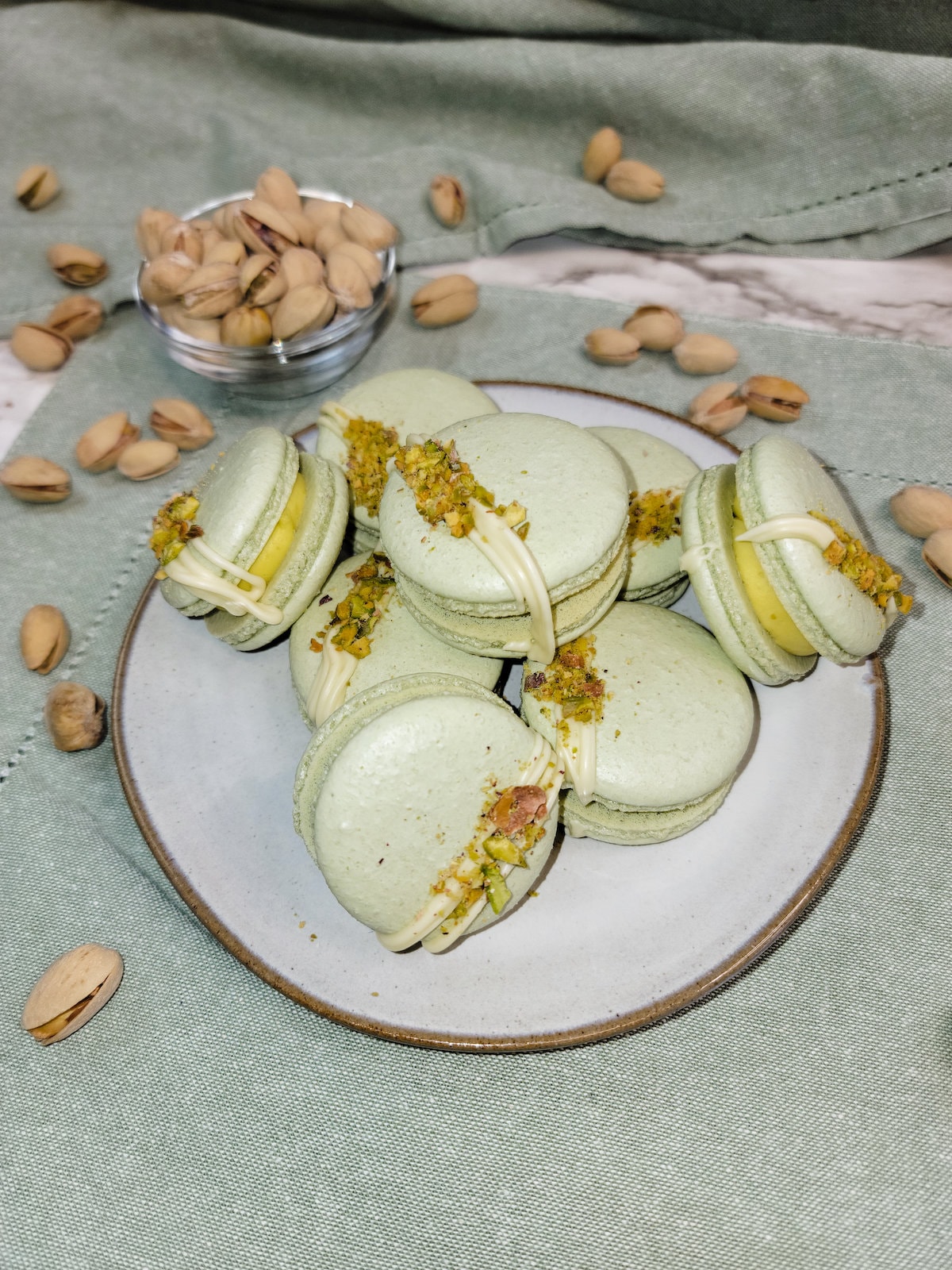
Pistachio White Chocolate Ganache Macarons
These pistachio white chocolate ganache macarons look fancy but are totally doable. Bite into a delicately crisp shell with the creamiest pistachio filling!
Print
Pin
Servings: 15
Calories: 190kcal
Equipment
Ingredients
FOR THE MACARONS:
- 130 g almond flour
- 130 g powdered sugar
- 90 g granulated sugar
- 100 g egg whites, room temperature
- 1 t. egg white powder
- ½ t. meringue powder
- Green food coloring gel
- Lemon juice for wiping the kitchen tools
FOR THE WHITE CHOCOLATE PISTACHIO GANACHE:
- 1 c. white chocolate chips (plus extra for the drizzle)
- ⅓ c. heavy whipping cream
- 1 t. crushed pistachios (plus extra for garnish)
Instructions
MACARONS:
- Preheat the oven to 300°F. Wipe the stand mixer bowl, whisk, and spatula with a paper towel and a little lemon juice to remove any residue that could affect the meringue’s stability.
- Measure all the ingredients for your pistachio French macarons to the gram using a kitchen scale.
- Flip the baking pan upside down and place the silicone macaron mat on top. If your mat does not have a template, line it with parchment paper. If it has a printed guide, you can pipe directly onto it.
- Add the egg whites to the stand mixer bowl and beat on medium speed for about a minute, until bubbly. Add the meringue powder and continue mixing for 2 to 3 minutes on medium speed, until the whisk starts leaving tracks and the mixture is just before soft peaks.
- Add the granulated sugar in three additions, mixing on medium speed and waiting about a minute between each addition.
- Once all the sugar is added, increase the speed to medium-high and mix for about 5 minutes, until stiff peaks form. The meringue should start gathering in the center of the whisk.
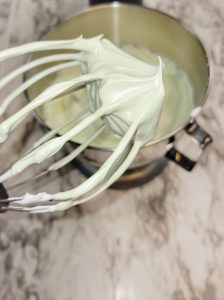
- Add the green gel food coloring and mix until evenly combined. Set the meringue aside.
- In a separate large bowl, combine the almond flour, powdered sugar, and egg white powder. Sift through a fine mesh strainer, using a spatula to help push it through. Discard any large bits and work quickly so the meringue does not dry out.
- Add the dry ingredients to the meringue. Fold gently to combine. Scrape along the sides, bring the batter over itself, then cut through the center. Repeat, making sure to reach the bottom and sides so no dry pockets remain.
- As the batter comes together into a thick mass, start deflating some of the air. This step is key to getting smooth, even macaron shells.
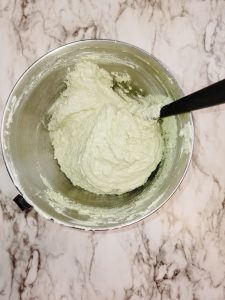
- Keep folding and test the batter by lifting some with your spatula and letting it fall. If it drops in clumps and sits on top, continue folding.
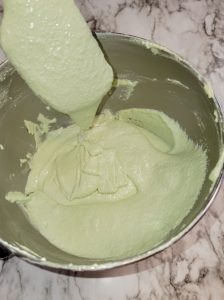
- Check every few turns until the batter flows smoothly off the spatula. It should fall in a ribbon, gently folding back into itself and slowly disappearing. The texture should resemble molten lava. Do not overmix.
- Prepare your piping bag by cutting the tip to fit your metal piping tip. Insert the tip and make sure nothing is blocking the opening.
- Place the piping bag tip-side down in a cup and fold the edges over the rim to hold it in place. Fill the bag halfway with batter, then twist the top closed.
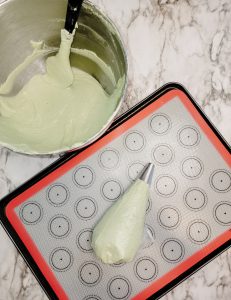
- Hold the bag perpendicular to the mat, about half an inch above the surface. Pipe directly into the center of each circle on the template. Keep your hand steady and avoid piping at an angle to prevent lopsided shells.
- Squeeze gently until each round is filled, then lift the bag straight up. Continue piping the rest.
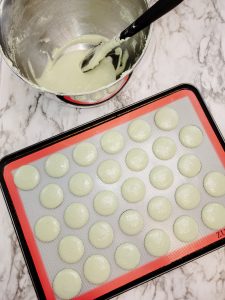
- Lift the pan and tap it gently on the counter to release air bubbles. Use a toothpick to pop any remaining bubbles.
- Let the piped shells rest for at least 30 minutes, or longer if it is humid. Lightly touch the tops to check. They should feel dry and not sticky.
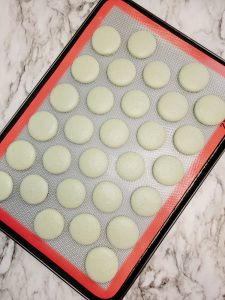
- Bake for 12 to 14 minutes. Rotate the trays halfway through and switch racks to help them bake evenly.
- Remove from the oven and let them cool completely before removing from the mat.
- To release, gently hold the edge of the mat and peel it away from the shells.
WHITE CHOCOLATE PISTACHIO GANACHE:
- In a microwave-safe bowl, combine the white chocolate chips and heavy cream. Melt in 30-second intervals, stirring in between each round until smooth and fully melted.
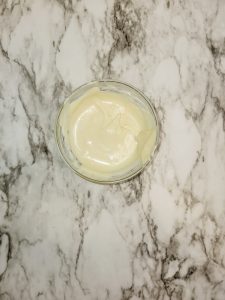
- Stir in the crushed pistachios until evenly combined. Let the mixture cool and firm up slightly.
- Transfer the white chocolate ganache for macarons to a stand mixer bowl and beat on medium speed for a few minutes, until smooth. It should look lighter and almost double in volume.
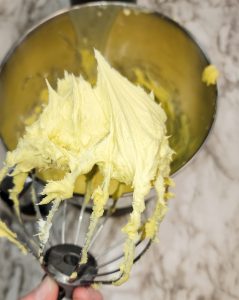
- Scrape down the sides of the bowl as needed to make sure everything is evenly incorporated.
- Transfer the pistachio white chocolate filling to a pastry bag.
- Cut about 1/2 inch off the tip of the bag. No piping tip is needed for this pistachio ganache for macarons.
ASSEMBLING THE PISTACHIO MACARONS:
- Place one macaron shell upside down with the smooth side facing up.
- Pipe the pistachio white chocolate ganache in a circular motion to cover the surface.
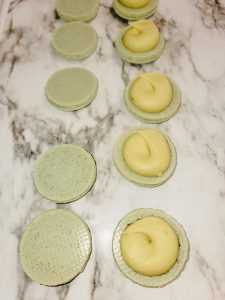
- Top with another macaron shell to create a sandwich. Repeat until all the filling and shells are used.
- Arrange the assembled macarons on a wire rack or a sheet of parchment paper.
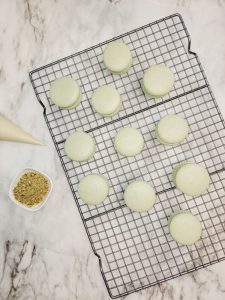
- Melt the remaining white chocolate in 30-second intervals, stirring in between, until smooth. Transfer to a pastry bag and cut a very small opening at the tip.
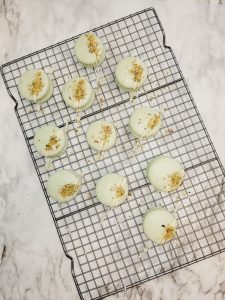
- Drizzle the melted chocolate back and forth over each macaron.
- Sprinkle with more crushed pistachios, then let the macarons sit until the topping is set.
Notes
- Sift your dry ingredients to ensure smooth pistachio macarons. During macaronage, when you fold the meringue into the almond flour mixture, aim for a lava-like batter. It is ready when you can draw a figure 8 without breaking. Finally, let the piped shells rest before baking.
- Chill your pistachio ganache macarons overnight. This allows the filling to soften the shells, giving you that coveted melt-in-the-mouth macaron texture. And for the best flavor, bring the white chocolate pistachio ganache macarons to room temperature before serving.
- You can store your pistachio macarons in an airtight container in the fridge for 5 to 7 days. For longer storage, freeze the unfilled shells for 2 to 3 months and thaw them in the fridge before assembly.
Nutrition
Serving: 1g | Calories: 190kcal | Carbohydrates: 24g | Protein: 4g | Fat: 11g | Saturated Fat: 5g | Polyunsaturated Fat: 2g | Monounsaturated Fat: 4g | Cholesterol: 15mg | Sodium: 40mg | Potassium: 120mg | Fiber: 2g | Sugar: 22g | Vitamin A: 250IU | Calcium: 60mg | Iron: 1mg